Friday, November 16, 2012

Thursday, November 15, 2012
Triangles elliott wave
Elliott wave triangle is side way market.
Key feature of triangle:

Main difference:


Key feature of triangle:
- volume and volatality will decrease

 |
| look traingle Here volume and volatality decreased simultaneously. |
Main difference:
- Here volatality and Volume will decrease but
- volume and volatality will not decrease in diagonal
- Consist of 5 overlapping abcde pattern
- 3-3-3-3-3-3 structure.
- Occurs in wave 4 and wave B
- that is before final actionary wave
- Formed by connection of BD, AC


Ending diagonal:
Characters:


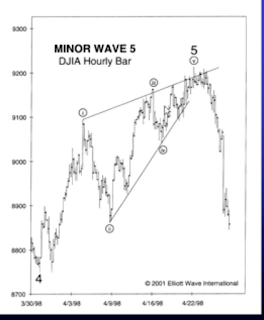
Where it can be found:
wave 5/ C
previously diagonal was named as diagonal triangle but now changed.


- It is most dynamic elliott wave pattern.
- It is termination pattern.
- It is motive wave, subdivided into 5 waves.
- It ushers( one who help other) trend reversal.
- It is in the direction of main trend.
- It is 33333 pattern.
- wave 4 moves within the territory of wave 1.
 |
| Ending diagonal. five wave subdivide into 3 each wave, indicates reversal. |
Where it can be found:
wave 5/ C
previously diagonal was named as diagonal triangle but now changed.
Wednesday, November 14, 2012
How to differentiate traingle from Diagnonal
Triangle:
Where it can be found:
it is usually found in wave 4, B, X
So it is found in side way market
Never 2/A wave
most interesting it forms channel also.
Some characters:
Consist of 5 wave
wave 4, 1 overlap
wave 4 can never go beyond the origin of wave 3
wave 3 can not be shortest one amoung 1, 3, 5
Here
trend line of A, C
and trend line of B,D makes the triangle
A diagonal is also 5 wave pattern
it is also two type
starting diagonal
Ending diagonal
Where it found:
Staring diagonal
is made up of 5 wave, 5 3 5 3 5 pattern
Found in 1,A wave
Some characters:
Ending diagonal:
where it can be found:
wave 5/C
- A triangle is made up of 5 wave.
- each wave subdivided into 3 wave
- So our wave structure is 3 3 3 3 3
- Each sub wave is corrective pattern
- here in triangle five wave is marked by
- a=1
- b=2
- c=3
- d=4
- e=5
- Some occasion wave 1 may be largest, some times wave 5 may be largest
- When wave 1 largest it is contracting triangle
- when wave 5 largest it is expanding triangle.
- market can be bull or bear in contracting or expanding triangle.
Where it can be found:
it is usually found in wave 4, B, X
So it is found in side way market
Never 2/A wave
most interesting it forms channel also.
Some characters:
Consist of 5 wave
wave 4, 1 overlap
wave 4 can never go beyond the origin of wave 3
wave 3 can not be shortest one amoung 1, 3, 5
Here
trend line of A, C
and trend line of B,D makes the triangle
A diagonal is also 5 wave pattern
it is also two type
starting diagonal
Ending diagonal
Where it found:
Staring diagonal
is made up of 5 wave, 5 3 5 3 5 pattern
Found in 1,A wave
Some characters:
- here wave 1, 4 overlaps
- wave 1,3 make a trend line
- and wave 2, 4 makes another which converge
- Volume tends to decrease or diminish when diagonal forms
- wave 4 can not go beyond the origin of wave 3
- wave 3 can never be shorter amoung 1,3,5
- Internally wave 1,3,5 have impulse pattern
- wave 5 shortest
- wave 1 is the longest
- wave 2, 4 alteration can be happen.
Ending diagonal:
- Properties same as starting diagonal
- But here each wave is subdivided into three wave giving rise to 33333 pattern.
- rest all properties are same
- here wave 1, 4 overlaps
- wave 1,3 make a trend line
- and wave 2, 4 makes another which converge
- Volume tends to decrease or diminish when diagonal forms
- wave 4 can not go beyond the origin of wave 3
- wave 3 can never be shorter amoung 1,3,5
- Internally wave havecorrective pattern
where it can be found:
wave 5/C
Friday, November 9, 2012
Elliott wave pattern: Triangle
Elliott wave pattern: Triangle
it is correction pattern
Seen in wave 4 , but can be seen in wave 2 also
Consist of five wave abcde
Types:
1. Contracting triangle:
Rules and guidelines
In which wave
Internal structure


it is correction pattern
Seen in wave 4 , but can be seen in wave 2 also
Consist of five wave abcde
Types:
- Contracting triangle
- Expanding triangle
1. Contracting triangle:
Description
A triangle is a corrective pattern, which can contract or expand. Furthermore it can ascend or descend. It is composed of five waves, each of them has a corrective nature.
o It is composed of 5 waves.
o Wave 4 and 1 do overlap.
o Wave 4 can’t go beyond the origin of wave 3.
o Wave 3 cannot be the shortest wave.
o Internally all waves of the diagonal have a corrective wave structure.
o In a contracting Triangle, wave 1 is the longest wave and wave 5 the shortest. In an expanding Triangle, wave 1 is the shortest and wave 5 the longest.
o Triangles normally have a wedged shape, which follows from the previous.
o As a guideline the internal wave structure should show alternation.
Triangles occur only in waves B, X and 4. Never in wave 2 or A.
It is composed of five waves, of which the internal structure is 3-3-3-3-3.
2, Expanding triangle:


for more visit
Elliott wave pattern- Zigzag
Elliott wave pattern- Zigzag( correcting wave pattern)
it is sharp correction
Occurs in wave 2 usually
It is 5 3 5 wave pattern


Description
A Zigzag is the most common corrective structure, which starts a sharp reversal. Often it looks like an impulsive wave, because of the acceleration it shows. A zigzag can extend itself into a double or triple zigzag, although this is not very common, because it lacks alternation (the same two patterns follow each other). Notice that the zigzag can only be the first part of a corrective structure.
Rules and guidelines
o It is composed of 3 waves.
o Waves A and C are impulses, wave B is corrective.
o The B wave retraces no more then 61.8% of A.
o The C wave must go beyond the end of A.
o The C wave normally is at least equal to A.


In which wave
Most of the time it happens in A, X or 2. Also quite common in B waves as a part of a Flat, (part of) Triangles and sometimes in 4.
Internal structure
A single Zigzag is composed of 3 waves, a double of 7 waves separated by an X wave in the middle, a triple of 11 waves separated by two X waves (see pictures below). The internal structure of the 3 waves is 5-3-5 in a single Zigzag, 5-3-5-3-5-3-5 in a double.
Example of a Double Zigzag
for more information visit http://www.elliottwave.com/grpcontent/patterns/zigzags.aspx
Elliott wave pattern- Diagonal( correcting wave pattern)
Elliott wave pattern- Diagonal( correcting wave pattern)
There are two form of diagonal triangle
1.Diagonal triangle type1/ Ending diagonal triangle

Description
Diagonals are sort of impulsive patterns, which normally occur in terminal waves like a fifth or a C wave. Don’t confuse them with corrective triangles.
Diagonals are relatively rare phenomena for large wave degrees, but they do occur often in lower wave degrees on intra-day charts. Usually Diagonal triangles are followed by a violent change in market direction.
Rules and guidelines
The most important rules and guidelines are:
o It is composed of 5 waves.
o Waves 4 and 1 do overlap.
o Wave 4 can’t go beyond the origin of wave 3.
o Wave 3) cannot be the shortest wave.
o Internally all waves of the diagonal have a corrective wave structure.
o Wave 1 is the longest wave and wave 5 the shortest.
o The channel lines of Diagonals must converge.
o As a guideline the internal wave structure should show alternation, which means different kind of corrective structures.
In which wave
Diagonal triangles type 1 occur in waves 5, C and sometimes in wave 1.
Internal structure
The internal structure of the five waves is 3-3-3-3-3.


2,Diagonal triangle type 2/ Starting/leading diagonal triangle
Description
Diagonal type 2 is a sort of impulsive pattern, which normally occurs in the first or A wave. The main difference with the Diagonal Triangle type 1 is the fact that waves 1, 3 and 5 have an internal structure of five waves instead of three. Experience shows it can also occur in a wave 5 or C, though the Elliott Wave Principle does not allow this. Don’t confuse this with corrective triangles.
Diagonals are relatively rare phenomena for large wave degrees, but they do occur often in lower wave degrees in intra day charts. These Diagonal triangles are not followed by a violent change in market direction, because it is not the end of a trend, except when it occurs in a fifth or a C wave.
Rules and guidelines
The most important rules and guidelines are:
o It is composed of 5 waves.
o Wave 4 and 1 do overlap.
o Wave 4 can’t go beyond the origin of wave 3.
o Wave 3) cannot be the shortest wave.
o Internally waves 1, 3 and 5 have an impulsive wave structure.
o Wave 1 is the longest wave and wave 5 the shortest.
o As a guideline the internal wave structure should show alternation, which means that wave 2 and 4 show a different kind of corrective structure.
In which wave
Diagonal triangles type 2 occur in waves 1 and A.
Internal structure
The five waves of the diagonal type 2 show an internal structure of 5-3-5-3-5.
for details visithttp://www.elliottwave.com/grpcontent/patterns/diagonals.aspx
There are two form of diagonal triangle
- Diagonal triangle type1/ Ending diagonal triangle
- Diagonal triangle type 2/ Starting/leading diagonal triangle
1.Diagonal triangle type1/ Ending diagonal triangle
Description
Diagonals are sort of impulsive patterns, which normally occur in terminal waves like a fifth or a C wave. Don’t confuse them with corrective triangles.
Diagonals are relatively rare phenomena for large wave degrees, but they do occur often in lower wave degrees on intra-day charts. Usually Diagonal triangles are followed by a violent change in market direction.
Rules and guidelines
The most important rules and guidelines are:
o It is composed of 5 waves.
o Waves 4 and 1 do overlap.
o Wave 4 can’t go beyond the origin of wave 3.
o Wave 3) cannot be the shortest wave.
o Internally all waves of the diagonal have a corrective wave structure.
o Wave 1 is the longest wave and wave 5 the shortest.
o The channel lines of Diagonals must converge.
o As a guideline the internal wave structure should show alternation, which means different kind of corrective structures.
In which wave
Diagonal triangles type 1 occur in waves 5, C and sometimes in wave 1.
Internal structure
The internal structure of the five waves is 3-3-3-3-3.
2,Diagonal triangle type 2/ Starting/leading diagonal triangle
Description
Diagonal type 2 is a sort of impulsive pattern, which normally occurs in the first or A wave. The main difference with the Diagonal Triangle type 1 is the fact that waves 1, 3 and 5 have an internal structure of five waves instead of three. Experience shows it can also occur in a wave 5 or C, though the Elliott Wave Principle does not allow this. Don’t confuse this with corrective triangles.
Diagonals are relatively rare phenomena for large wave degrees, but they do occur often in lower wave degrees in intra day charts. These Diagonal triangles are not followed by a violent change in market direction, because it is not the end of a trend, except when it occurs in a fifth or a C wave.
Rules and guidelines
The most important rules and guidelines are:
o It is composed of 5 waves.
o Wave 4 and 1 do overlap.
o Wave 4 can’t go beyond the origin of wave 3.
o Wave 3) cannot be the shortest wave.
o Internally waves 1, 3 and 5 have an impulsive wave structure.
o Wave 1 is the longest wave and wave 5 the shortest.
o As a guideline the internal wave structure should show alternation, which means that wave 2 and 4 show a different kind of corrective structure.
In which wave
Diagonal triangles type 2 occur in waves 1 and A.
Internal structure
The five waves of the diagonal type 2 show an internal structure of 5-3-5-3-5.

for details visithttp://www.elliottwave.com/grpcontent/patterns/diagonals.aspx
Subscribe to:
Posts (Atom)